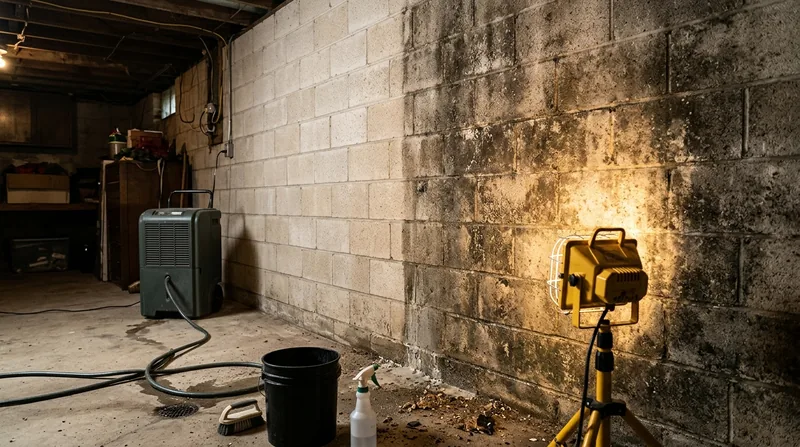




If you are dealing with Basement Mold Remediation in Green Bay, you already know the musty smell and the dark staining on the lower block are symptoms, not the root cause. Green Bay sits on glacial till and clay over Silurian dolomite, and the same limestone ridge that carries the Niagara Escarpment runs beneath many lots here. In the 1900s to 1930s bungalows and foursquares Downtown, on the East Side and in Navarino, that means fieldstone and early poured walls that weep after every spring thaw. In the 1950s to 1970s ranches of Bay Beach, Shorewood and Ashwaubenon, it means hairline cracks opened by deep frost and freeze-thaw cycles. We treat the mold and fix the moisture path feeding it, so the growth does not come back. Start with a free basement inspection and we will tell you plainly whether you need crack sealing, drainage, or just better dehumidification.
Why Basement Mold Grows So Fast in Green Bay's Older Bungalows and Foursquares
Mold needs three things: moisture, organic material, and still air. Green Bay basements supply all three in abundance. Fieldstone and early poured walls in Navarino and Downtown hold damp long after the spring water table drops, and the partly finished basements common in Broadway and Howe trap that humidity behind paneling and carpet. Add fast runoff from heavy summer storms pushing water against footing drains, and you have a recipe for recurring growth on joists, sill plates, and the back of drywall.
- Hydrostatic pressure forces water through fieldstone mortar joints and early poured wall cracks, keeping the block saturated for weeks.
- Efflorescence on the lower wall is a reliable sign that moisture is moving through the masonry, not just condensing on it.
- Warm, humid summer air hitting a cool basement wall condenses and feeds surface mold even when no water is visible.
- Failed sump pumps or short discharge lines leave standing water in the sump basin and along the interior perimeter drain.
- Clogged or collapsed weeping tile around 1920s foundations lets water sit against the footing instead of draining away.
In every one of those cases, treating the visible mold without correcting the moisture source is a short-term fix that fails by the next wet season.
Key info: A foursquare on the East Side with a fieldstone foundation and a musty smell in June is usually showing groundwater seepage, not a one-time spill. We check the wall base, the sump basin, and the discharge line before we quote any remediation.
For official guidance on moisture and mold in buildings, the U.S. EPA maintains a plain-language resource at epa.gov/mold that pairs well with what we find on site.
How We Run Basement Mold Remediation in Green Bay, Step by Step
Our process starts with moisture diagnostics, not with a sprayer. We map where the water is entering, measure relative humidity at the wall base and mid-wall, and check the sump and drain tile before we set up containment. That order matters in Green Bay because a damp basement in Howard or Suamico with a poured wall and a working sump often needs dehumidification and sealing, while a 1920s Broadway basement with a wet fieldstone wall needs drainage work first.
- We inspect the foundation, wall base, sump basin, and discharge line, and we note efflorescence, staining, and any bowing wall or cracked mortar joint.
- We set up containment with poly sheeting and negative air pressure so spores do not spread into the finished side of the basement.
- We remove and bag porous materials that cannot be cleaned, such as wet drywall, insulation, and carpet, and we HEPA-vacuum the affected framing and masonry.
- We treat affected surfaces with an EPA-registered antimicrobial and scrub the joists, sill plates, and wall face.
- We correct the moisture path, which may mean epoxy or polyurethane injection at a crack, an interior perimeter drain, a sump pump replacement, or a vapor barrier and dehumidification.
- We verify dryness with moisture readings and give you a written summary of what we removed, what we treated, and what we changed.
Every job ends with a clear record of the moisture readings so you can see the before and after, not just take our word for it.
Key info: A split-level in Ashwaubenon with mold on the lower wall of a walkout often has a grading and downspout issue on the uphill side. We extend the downspout, correct the grade, and treat the wall, which is far cheaper than excavating a foundation that only needed water moved away from it.
If the inspection shows the wall is staying wet from the outside, we move to basement waterproofing rather than repeating surface treatment.
Remediation and Moisture-Control Methods We Use in Green Bay Basements
Not every basement needs the same approach. The table below shows the methods we actually use and when each one is the right call for a Green Bay foundation, from a fieldstone wall in Navarino to a poured walkout in Ledgeview.
| Approach | Description | Best for |
|---|---|---|
| Containment and HEPA removal | Poly sheeting, negative air, HEPA vacuuming, and bagged disposal of porous materials. | Visible growth on drywall, carpet, or framing in finished basements. |
| Antimicrobial treatment and scrubbing | EPA-registered product applied to joists, sill plates, and masonry after cleaning. | Surface growth on fieldstone, block, and poured walls. |
| Crack injection and wall sealing | Epoxy or polyurethane injection at cracks, plus parging or sealer at the wall face. | Hairline cracks opened by freeze-thaw, and damp but structurally sound walls. |
| Drainage correction | Interior perimeter drain, drain tile repair, sump pump replacement, and discharge line extension. | Hydrostatic pressure and water table rise pushing water through the wall base. |
| Dehumidification and vapor control | Vapor barrier and controlled dehumidification to hold basement humidity down. | Condensation-driven growth in partly finished basements with no visible seepage. |
We choose the lightest method that solves the moisture problem, and we tell you when a simple crack seal is enough.
Basement Mold Remediation Cost in Green Bay: What to Expect
Most residential remediation in Green Bay starts around $1,500 for a contained, single-room job with surface treatment and a moisture correction such as crack injection or downspout and grading work. A larger finished basement with wet drywall, insulation, and carpet removal runs higher, and the number moves most when drainage work is added. The size of the affected area, whether materials are porous, how many rooms are involved, and whether the fix requires an interior drain tile system or a sump pump replacement all drive the final figure.
We quote the remediation and the moisture fix as separate line items so you can see exactly what you are paying for. Getting two or three estimates is smart in this trade, and any contractor who quotes a number over the phone without seeing the wall base and the sump is guessing. Our full pricing overview lays out the ranges we work from.
Basement Mold Remediation Near Me: How to Vet a Contractor Near Green Bay
You want a contractor who will show you the moisture source, not just sell you a spray. Ask for proof of licensing and insurance, ask how they contain the work area, and ask what happens if the growth returns because the water was never corrected. A straight answer on that last question tells you more than any brochure.
- Confirm the company is licensed and insured, and ask for a certificate of insurance before work begins.
- Get two or three written estimates that separate remediation from the moisture correction.
- Ask for local references from Green Bay, De Pere, or Ashwaubenon basements similar to yours.
- Ask whether the scope includes moisture readings before and after, and a written summary.
- If structural work such as bowing wall repair or egress window cutting is involved, confirm the contractor pulls permits with the local building department, since rules vary by jurisdiction and must be verified.
If a contractor cannot explain why your wall is wet, keep looking. You can reach us through our contact page to set up an inspection.
Basement Mold Remediation in Green Bay: Pricing Guide
| Service | Price | Details |
|---|---|---|
| Contained single-room remediation | Starting at $1,500 | Includes containment, HEPA vacuuming, antimicrobial treatment, and a written moisture summary after drying. |
| Finished basement with porous materials | Starting at $2,800 | Adds removal and disposal of wet drywall, insulation, and carpet, plus framing and masonry treatment. |
| Remediation plus drainage correction | Starting at $4,500 | Pairs treatment with crack injection, interior perimeter drain, or sump pump replacement to stop the water source. |
| Complex or large-scale job | On estimate | Multiple rooms, structural wall concerns, or fieldstone foundations need an on-site look before a number is given. |
| Travel | Included | In Green Bay and surrounding areas, with no separate call-out or mileage fee added to the quote. |
| Estimate | Free | Response within 24 hours at (920) 932-4887, with no obligation to book the work. |
Indicative pricing, the exact cost depends on square footage, finish, and site access. Free personalized estimate within 24h at (920) 932-4887.


