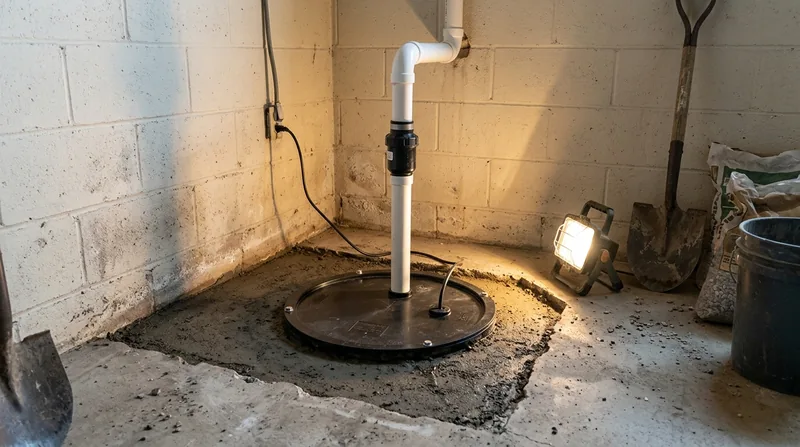




Sump pump installation and replacement in Green Bay starts with one hard fact: this city sits on glacial till and clay over Silurian dolomite, and that limestone ridge under the Niagara Escarpment sends water through seams straight toward your footing drain. Downtown and East Side bungalows from the 1900s to 1930s often still run on a fieldstone or early poured basin with a pump that has no check valve and a discharge line that ends two feet from the wall. When the Fox River pushes spring high water and summer storms dump fast runoff, that setup fails at 2 a.m. We size the pump to the actual inflow, seal the basin, and route the discharge so it dumps onto grade and away, not back against the foundation. If your pump is cycling, humming, or the basin is filling faster than it empties, start with a free basement inspection before the next rain.
Why Sump Pump Failures Hit Green Bay Basements So Hard
Green Bay basements take water from three directions at once. The water table rises with spring melt, the clay till holds storm runoff against the wall, and fractured dolomite under lots in Howard, Suamico and Ledgeview lets groundwater move along rock seams. A pump that was adequate in a dry October is overwhelmed by April, and the failure mode that dominates here is a burned-out motor or a float stuck by grit after a summer of heavy rain.
- Homes in Navarino and Broadway often have shallow, undersized basins that fill in minutes during a storm.
- 1950s to 1970s ranches in Ashwaubenon and Shorewood were built with 1/3 HP pumps that cannot keep up with modern runoff.
- Freeze-thaw cycles open hairline wall cracks and let water reach the basin faster than the old drain tile can carry it.
- Discharge lines that dump at the wall send water back into the same clay soil, so the pump runs nonstop.
If the basin is filling from below the slab rather than from wall seepage, the pump is only half the answer and an interior drain tile system may be the correct fix.
Key info: A 1952 ranch in Ashwaubenon had a 1/3 HP pump on a 15-inch basin with no check valve. Every storm cycle it pumped water out, then let it drain straight back down the discharge line. We replaced it with a 1/2 HP cast-iron pump on a 24-inch sealed basin with a check valve and a freeze-protected discharge to a dry well, and the pump stopped short-cycling.
Permits and discharge rules vary by jurisdiction in Brown County, so confirm sump discharge routing with the local building department before work begins. The City of Green Bay publishes permit guidance at greenbaywi.gov.
How We Install or Replace a Sump Pump in Green Bay
We start by measuring what the basin actually takes in, not by matching the old pump's horsepower. On a 1920s brick colonial in Howe with a partly finished basement, that means watching the basin through a rain event, checking the drain tile inlet, and confirming whether water arrives from the footing drain or through wall seepage. The install follows the same sequence on every job, whether it is a straight swap in Bellevue or a new pit cut into a slab in Allouez.
- We inspect the basin, inlet tile and discharge route, and note any wall seepage or efflorescence that points to hydrostatic pressure.
- We cut and set a properly sized basin with a sealed lid, gravel bed and weep holes so groundwater enters the pit, not the slab edge.
- We set the pump on a solid base, install a check valve, and plumb a discharge line with a freeze-protected slope and a proper air gap or frost-free termination.
- We wire the pump to a dedicated GFCI circuit and test the float through a full fill-and-empty cycle.
- We recommend a battery backup or secondary pump where spring melt and summer storms overlap, and we verify the discharge outlet moves water away from the foundation.
Every install ends with a wet test, a clear explanation of the float settings, and a written note on what to check before the first spring thaw.
Key info: In a 1998 walkout in Suamico, the original discharge line ran uphill to a pop-up emitter that froze shut in February. Meltwater backed into the basin and the pump ran dry, then burned out. We re-routed the line to a gravity-fed dry well with a freeze-protected slope, and added a battery backup sump pump for storm outages.
Sump Pump Approaches We Use in Green Bay
The right approach depends on whether water enters through the footing drain, through the wall, or both. We match the method to the failure we find, and we tell you plainly when a simple replacement is enough.
| Approach | Description | Best for |
|---|---|---|
| Direct pump replacement | Swap the pump, check valve and float on an existing sound basin | Working basin, burned-out or undersized pump |
| New basin and pump | Cut and set a larger sealed basin with gravel bed and new discharge | Shallow or cracked basin, chronic short-cycling |
| Pump plus interior drain | Add an interior perimeter drain that feeds the new basin | Wall seepage and hydrostatic pressure at the cove |
| Battery backup system | Secondary pump on a charged battery with alarm | Storm outages, spring melt, travel or vacancy |
| Discharge line correction | Re-route the line to grade or a dry well with freeze protection | Water returning to the wall, frozen or buried outlets |
Sump Pump Installation & Replacement Cost in Green Bay: What to Expect
Most Green Bay homeowners spend from $1,200 for a straightforward pump replacement on an existing basin with a new check valve and discharge correction. The number moves with basin size, pump capacity, discharge routing and whether the job needs a new pit cut into a slab. A fieldstone basement in Navarino with a shallow pit and no gravel bed costs more than a 2005 poured basement in Howard with a clean 24-inch basin already in place.
Access matters too. A finished basement with a tight mechanical closet takes longer than an open slab, and a discharge line that has to reach a dry well across a driveway adds trenching. We quote the pump, basin, check valve, discharge, electrical connection and haul-away as separate lines so you can see what drives the price. Get two or three estimates and compare the pump model, basin size and discharge plan, not just the bottom line.
Our full pricing overview breaks down the line items, and the estimate itself is free.
What to Look For in a Sump Pump Contractor Near Me in Green Bay
Ask three questions before you sign: are you licensed and insured, what pump model and basin size are in the quote, and who pulls the permit if the discharge routing changes. A contractor who cannot name the pump's horsepower and the basin diameter is guessing. Ask for references from jobs in Green Bay or De Pere with the same basement type as yours, and confirm the discharge plan in writing.
- Confirm the company carries liability insurance and workers' compensation, and ask for a certificate.
- Get the pump make, model and horsepower in the written estimate, not just a lump sum.
- Ask whether the discharge will terminate at grade, at a dry well, or at a storm connection, and who verifies it with the building department.
- Check references for jobs done at least one full spring melt after installation.
Reach us through the contact page to schedule a free inspection.
Sump Pump Installation & Replacement in Green Bay: Pricing Guide
| Service | Price | Details |
|---|---|---|
| Pump replacement on existing basin | Starting at $1,200 | Includes new pump, check valve, float and discharge correction on a sound basin |
| New basin and pump installation | Starting at $1,850 | Cut and set a larger sealed basin with gravel bed, new pump and discharge |
| Pump with interior drain tie-in | On estimate | Scope depends on wall seepage and how much perimeter drain is needed |
| Battery backup system | Starting at $650 | Secondary pump, charged battery, alarm and tie-in to the existing discharge |
| Travel | Included | In Green Bay and surrounding areas, no separate call-out or mileage fee |
| Estimate | Free | Response within 24h at (920) 932-4887, no obligation to book |
Indicative pricing, the exact cost depends on square footage, finish, and site access. Free personalized estimate within 24h at (920) 932-4887.


