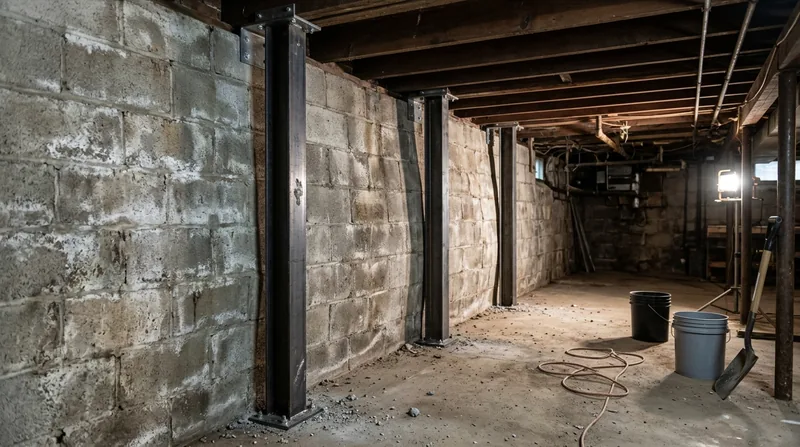




Bowing Wall Repair in Green Bay: When Clay and Frost Push Back
Green Bay sits on glacial till and clay over Silurian dolomite, and that ground moves with the seasons. Downtown brick foursquares, East Side bungalows and Navarino homes with fieldstone or early poured basements take the worst of it when spring high water and Fox River runoff load the soil behind the wall. A wall that leans, bulges or shows a horizontal crack near the middle is telling you the pressure is coming from outside, not from the room.
We handle Bowing Wall Repair in Green Bay with carbon fiber straps, steel I-beams and wall anchors sized to the movement and the soil. If your wall is stable but wet, start with foundation crack repair and drainage first. If it is moving, stabilization comes before anything cosmetic.
Why Bowing Walls Show Up So Often in Green Bay's Older Basements
Most of the bowing we see is in 1900s to 1950s masonry, where lime mortar has softened and the wall has lost stiffness. Wet clay soil pushes laterally, frost drives water deeper, and a footing drain that has silted shut leaves hydrostatic pressure with nowhere to go. A 1920s brick colonial in Broadway with a full block basement is a classic candidate.
- Horizontal cracking in the middle third of the wall usually means lateral soil pressure, not settlement.
- Efflorescence and white staining on block tell you water is moving through and evaporating at the face.
- Doors and windows that stick on one side of the house can signal a wall rotating inward.
- Stair-step cracking near the corners points to differential movement that needs a closer look.
Any one of these signs is worth an inspection before you finish or reframe the basement.
Key info: In Ashwaubenon and Shorewood split-levels from the 1960s and 1970s, we often find bowing on the uphill side where grading sends runoff straight at the wall. Fixing the grading and the downspout extensions matters as much as the straps.
For structural foundation work, permits are commonly required and thresholds vary by jurisdiction. Verify with the City of Green Bay building department before work starts.
How We Diagnose and Stabilize a Bowing Wall in Green Bay
We start by measuring the wall, not guessing at it. A plumb line, a laser level and a few readings along the length tell us how much movement is real and how much is cosmetic. Then we look at the soil side: where the water goes, what the drain tile is doing and whether the wall is cracked through or just deflected.
- We inspect the full perimeter and record the deflection at the worst point.
- We check the footing drain and look for hydrostatic pressure evidence such as seepage at the cove joint.
- We recommend the least invasive method that actually arrests the movement.
- We install carbon fiber straps, steel I-beams or wall anchors and torque them to spec.
- We seal the wall face and address the water source so the repair is not fighting a wet wall.
The goal is to stop the movement first, then correct the moisture that caused it.
Key info: A Suamico walkout with a poured wall and a bulging section near the rear corner is a different job from a fieldstone wall in Navarino. The poured wall takes straps and anchors cleanly; the stone wall may need a reinforced beam and repointing first. We quote them differently because they behave differently.
If the water is the main problem, an interior drain tile system is often the better answer than exterior excavation, especially on a finished basement.
Repair Methods We Use and When Each One Fits
| Approach | Description | Best for |
|---|---|---|
| Carbon fiber straps | Straps bonded floor to sill plate to resist inward movement. | Block and poured walls with moderate bowing. |
| Steel I-beams | Vertical steel beams anchored at floor and joist. | Heavier deflection and longer wall runs. |
| Wall anchors | Exterior anchor plates tied through the wall to inside plates. | Walls that can be pulled back gradually. |
| Epoxy or polyurethane injection | Ports set into cracks and resin injected under pressure. | Non-structural cracks and seepage, not active bowing. |
| Drainage correction | Drain tile, grading and downspout extensions to relieve pressure. | Wet clay lots and failed footing drains. |
We match the method to the wall and the soil, not to a sales script.
Bowing Wall Repair Cost in Green Bay: What to Expect
Small, localized work such as crack injection and wall sealing starts from $600. Full stabilization with carbon fiber straps or steel beams runs higher because the material, engineering and labor scale with wall length and deflection. Wall anchors cost more again because they involve exterior excavation and anchor plates. Get two or three written estimates and compare scope, not just the bottom line.
Access matters. A wall behind a finished basement or a furnace room takes more setup than an open wall. Soil type matters too; heavy glacial clay loads the wall harder than sandy till. For a fuller breakdown, see our pricing overview.
Choosing a Bowing Wall Repair Contractor Near Green Bay
Ask for license and insurance certificates before anyone touches the wall. Ask how they measure deflection and what method they propose, and make them explain why that method fits your soil. A contractor who quotes a price without measuring is guessing.
- Confirm the company carries current liability and workers' compensation coverage.
- Get at least two references from jobs with the same wall type and soil.
- Ask who pulls the permit and whether structural work is inspected.
- Check HOA rules in Howard and Suamico subdivisions before exterior excavation.
If a quote sounds too good, it usually skips the drainage correction that keeps the wall stable.
Ready to get a real number? Contact us for a free basement inspection at (920) 932-4887.
Bowing Wall Repair in Green Bay: Pricing Guide
| Service | Price | Details |
|---|---|---|
| Crack injection and wall sealing | Starting at $600 | Includes port installation, epoxy or polyurethane injection and surface sealing on accessible cracks. |
| Carbon fiber strap installation | Starting at $1,800 | Includes straps floor to sill plate; price rises with wall length and number of straps. |
| Steel I-beam stabilization | Starting at $3,200 | Includes beams anchored at floor and joist; heavier deflection and longer runs cost more. |
| Wall anchor system | On estimate | Exterior excavation and anchor plates require an on-site look at soil and access. |
| Travel | Included | In Green Bay and surrounding areas, no separate call-out or mileage fee. |
| Estimate | Free | Response within 24h at (920) 932-4887, no obligation to book. |
Indicative pricing, the exact cost depends on square footage, finish, and site access. Free personalized estimate within 24h at (920) 932-4887.


