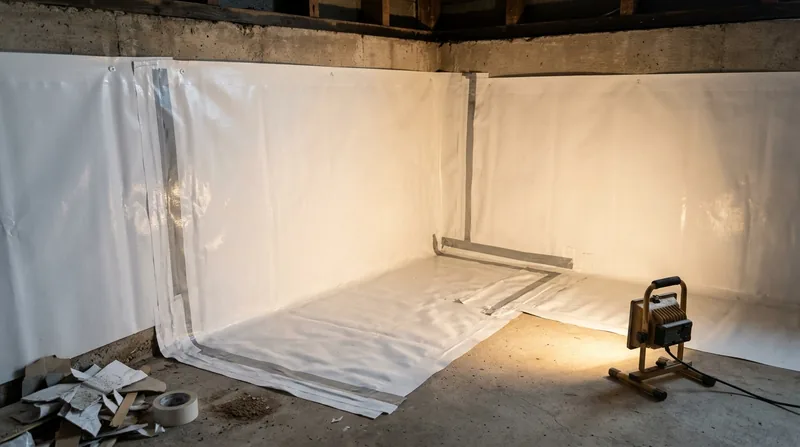




Vapor Barrier Installation in Green Bay is the work of stopping ground moisture vapor before it reaches the living space of your basement. This city sits on glacial till and clay over the Silurian dolomite ridge, and that geology decides how water behaves under your slab. Downtown bungalows and East Side foursquares often have fieldstone or early poured walls that sweat from the inside all summer. Ranches in Ashwaubenon and split-levels in Shorewood pull damp through the slab after every heavy storm. We install heavy-duty barrier sheets across walls and slab, seal the seams, tape the terminations and tie the system into the sump where the layout calls for it. If you want the full picture of how this fits with drainage, start with our basement waterproofing service.
Why Green Bay Basements Sweat Through Summer
Green Bay homes sit on clay that holds water like a sponge, and the fractured dolomite seams under some lots give that water a path straight up to the footing. Deep frost and lake-effect snow load the soil through winter, then spring thaw releases it against the wall. That is why so many 1920s brick colonials in Broadway and Howe show efflorescence and a musty smell by June. A vapor barrier addresses the vapor side of the problem, not the bulk water side.
- Clay and glacial till hold moisture against the wall for weeks after rain stops.
- Freeze-thaw cycles open hairline cracks that let vapor and seepage through.
- Finished basement panels trap damp against framing and hide the evidence.
- Spring high water on the Fox River and the Lake Michigan shore raises the water table on low lots.
When the barrier goes in correctly, the wall and slab stay dry enough that moisture control becomes routine instead of a fight.
Key info: A 1950s ranch in Ashwaubenon with visible efflorescence on the lower block and no standing water usually needs vapor control and wall sealing, not excavation. A 1930s foursquare in Navarino with water on the floor after every storm needs drainage first. We tell you which one you have.
For the code side, the City of Green Bay Inspection Department handles permits, and drainage work that alters the sump discharge connection commonly requires one. Rules vary, so verify before work starts: City of Green Bay.
How We Install a Vapor Barrier in a Green Bay Basement
We start by reading the basement, not by rolling out plastic. The inspection tells us whether the moisture is vapor coming through the slab, seepage through the wall, or hydrostatic pressure pushing water up at the cove joint. Each one takes a different approach, and putting a barrier over an active leak traps the problem instead of solving it.
- We walk the perimeter and check the cove joint, wall cracks, efflorescence and sump basin condition.
- We test for slab moisture and confirm whether the footing drain is moving water or clogged.
- We correct wall seepage first, with crack injection or wall sealing as needed, before any sheet goes up.
- We install the barrier across the wall and lap it onto the slab with sealed seams and taped terminations.
- We integrate the barrier with the sump basin and check valve so the discharge line stays clear.
- We leave the basement clean and show you what was done and what to watch for.
If the inspection turns up an active water path, we say so before we quote the barrier.
Key info: On a 1990s poured-wall home in Howard with a walkout, we found the barrier had been run over a settled slab edge without a termination. Water wicked up behind it and soaked the bottom of the drywall. We re-terminated the sheet, sealed the joint and tied it to the sump. Two days, no excavation.
If your inspection shows the real issue is water volume, our interior drain tile system is the better answer than a barrier alone. For homes in the 54302 ZIP, see our local vapor barrier page.
Vapor Barrier Approaches We Use
Not every basement takes the same sheet or the same fastening method. The table below shows how we match the approach to the building stock we see across Green Bay.
| Approach | Description | Best for |
|---|---|---|
| Wall and slab sheet barrier | Heavy-duty sheet lapped from wall to slab, seams sealed and terminations taped | Full basements with slab vapor and lower wall damp |
| Dimple board against the wall | Drainage mat that holds the sheet off the wall and lets moisture fall to the perimeter | Fieldstone and dolomite walls that stay damp year round |
| Sump-integrated barrier | Barrier tied into the sump basin with check valve and clear discharge line | Basements with an active sump and spring high water |
| Barrier over crack repair | Epoxy or polyurethane injection completed first, then the sheet installed over the repaired wall | Walls with hairline cracks opened by freeze-thaw |
| Partial barrier for finished space | Barrier on the lower wall and slab edge where framed walls stop short | Partly finished basements in Broadway and Howe |
The right row depends on what the inspection finds, not on what is easiest to sell.
Vapor Barrier Installation Cost in Green Bay: What to Expect
Most barrier work in this market starts from $3 per square foot, and that figure covers the sheet, sealed seams, taped terminations and the labor to fit it around obstructions. From there, the number moves with the basement, not with the calendar. A clean poured wall in Suamico prices differently than a rubble fieldstone wall in Navarino that needs parging before anything sticks.
- Wall condition drives most of the spread, since fieldstone and spalled block need prep before the sheet goes up.
- Finished basements cost more because we pull and reset framing and drywall to reach the wall.
- Sump integration and check valve work add a line item when the basin needs attention.
- Crack injection done first adds cost, but skipping it means the barrier fails at the crack.
- Access matters in tight 1920s basements with low headroom and narrow stairs.
Get two or three estimates and compare scope, not just the bottom line. A quote that skips the crack repair is not the same job. Our full pricing overview breaks down how each line item is built.
Choosing a Waterproofing Contractor Near Green Bay
Ask three questions before anyone rolls a sheet into your basement. First, are they licensed and insured for this work, and can they show the certificate. Second, does the estimate name the wall prep and crack repair, or does it assume a clean wall. Third, will they pull the permit when the work touches the sump discharge, because the City of Green Bay Inspection Department expects one for drainage alterations and the rules vary by jurisdiction.
- Get at least two written estimates with scope spelled out line by line.
- Ask for local references from basements built like yours, not just newer homes.
- Confirm the crew will correct wall seepage before installing the barrier.
- Check that the company carries liability and workers compensation coverage.
If a contractor promises a lifetime warranty or quotes a barrier over an active leak without inspection, keep looking. Reach us through our contact page and we will walk your basement and tell you what it actually needs.
Vapor Barrier Installation in Green Bay: Pricing Guide
| Service | Price | Details |
|---|---|---|
| Wall and slab sheet barrier | Starting at $3/sq ft | Includes heavy-duty sheet, sealed seams and taped terminations; wall condition moves the price |
| Dimple board on fieldstone or dolomite | Starting at $4.50/sq ft | Includes drainage mat and prep parging; uneven rubble walls add labor hours |
| Sump-integrated barrier | Starting at $3.75/sq ft | Includes basin tie-in and check valve check; discharge line routing adds cost |
| Barrier over crack injection | On estimate | Injection scope varies by crack count and wall type, so we price after inspection |
| Travel | Included | in Green Bay and surrounding areas, no separate call-out or mileage fee |
| Estimate | Free | Response within 24h at (920) 932-4887, no obligation to book |
Indicative pricing, the exact cost depends on square footage, finish, and site access. Free personalized estimate within 24h at (920) 932-4887.


